

-
Authority: Quantitative vs. the qualitative
- Limiting the scope of understanding
- Limiting the scope of discussion
- First things last and last things first
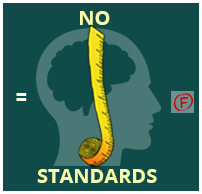
Here we see clear proof the American system is not broken because effective action is clearly feasible. Assuming Congressman X’s remarks about the citizenry’s ignorance was indeed a signal to the public to wise up, we can see even the systems hardened cynics know how much power and responsibility the people of the United Sates have; or could. Missing that signal unfortunately are our people. As petty animosities spread and the discrediting of our electoral system intensifies, conventional wisdom reigns, critical thinking stops, and the defeat of civics is complete. The dismay is reinforced as little “forensic” analysis can be found as why our electoral efforts have so little affect and what’s really behind the dysfunctions. If pursued, such inquiry would show that our reliance on elite methodologies of quantitative study to understand our world is a crucial in all this. This influential hidden hand takes our complex, interconnected society and reduces it to counting, classifying, and constructing statistical “models” to understand the quality of human relations. While numbers have their place, the lack of a qualitative balance in these matters inevitably sheds our most pressing questions of context; further clouding everything that follows. This fetish also serves to seduce our public sphere with the dangerous promise of certainty. Confident that numbers tell us what is happening, signals are sent that conventional wisdom should be accepted without question because it comes from authorities; in this case, chiefly, our domain of academic political science. As the "Networks Rule" piece demonstates, this is a discipline with much more influence than might be commonly understood. An example of statistics, removed from context, “telling a story” cite the some 45-50% of Americans that do not identify with either major political party; which is reported as a crisis of democracy. However, what such “authoritative” pronouncements fail to take into account is that population, or a large portion of it, might not so identify because they are firmly in the camp of the disinterested most! It also ignores these possibilities:
-
In their state,
22 of 30 (75%) the most populous cities in the nation conduct their local, municipal elections on a nonpartisan basis. It is a safe bet after past 30, the percentage goes up considerably.
http://www.nlc.org/partisan-vs-nonpartisan-elections where they live, the elections they vote in are held on a nonpartisan basis -
In their state,
General elections of course never restrict based on party affiliation.
Demonstrating only a mild hodgepodge some sources say 35 of the 50 United States’ operate their state and federal elections on a basis where party affiliation does not restrict the vote; leaving only 15 that do.
The numbers and methods are changeable so according to Wikipedia the number is 13 that do so restrict. However, according to Ballotpedia the number of states where the parties conduct fully closed primaries (one’s might be open and the others closed) - and where both parties vote is restricted - is only 12.
Though the methods of restricting or allowing the vote based on party affiliation might be arguable and controversial, what is clear is that there is substantial room for the voter to maneuver and party affiliation hardly constitutes monolithic control.
https://ballotpedia.org/Primary_election
http://www.independentvoterproject.org/primaries
https://en.wikipedia.org/wiki/Primary_elections_in_the_United_States#Types_of_primaries where they live no party affiliation is required in order to cast a nominating primary vote - as is mostly the case throughout the country